An AI agency. Without the delivery.
You already know twenty businesses that need this. What you have never had is something to sell them that does not hand you the work afterwards. That is what this changes.
Six things that are true about this business.
- Every business that sells something expensive is paying to talk to people who were never able to buy. The owner knows it. Until recently there was nothing they could do about it, because the only way to find out was to get somebody on the phone and ask.
- That changed. A lead can now be read on real financial data the moment they arrive, with a soft check that has no impact on anybody's credit score. The ranking happens before the call instead of during it.
- The software exists and it is already installed in businesses. We built it, we sell it ourselves, and we install every one. The problem is not the technology.
- The problem is that almost no owner knows this is possible. That is a distribution gap, and distribution is the one thing software cannot solve on its own.
- You close it. One product, one fixed price, no proposals and no quotes. You have the conversation. We install, onboard and support every business you sell.
- You are paid inside the transaction. 80% of the install price lands in your own Stripe account in the same payment the business makes. Nothing is held.
Every agency hits the same ceiling. It is never sales. It is delivery.
You can always sell more. What you cannot do is deliver more without hiring, managing, and inheriting every problem that comes with it. That is the wall, and it is the reason most good operators stay exactly where they are.
What is it?
The problem, the software, and the businesses it is built for.
Why this exists now, and not five years ago.
Every business that sells something expensive has the same problem. Most of them have never had a name for it, and until recently there was nothing anybody could do about it anyway.
Every high ticket business runs on leads it pays for
A clinic, a roofing company, a coach, a consultancy. They all buy attention. The lead arrives, somebody books a call, and a human being spends real time in front of that person before anybody knows whether they were ever in a position to buy.
The only qualifying tool anybody had was a question
What is your budget. Are you ready to move forward. How soon are you looking to start. Every one of those relies on the lead telling the truth about their own money, to a stranger, in a form, before they trust anybody. People type whatever gets them the call. Everybody in sales knows this and nobody had an alternative.
So the calendar fills with whoever filled in a form best
Not whoever can actually buy. The owner pays for the lead, pays for the closer's hour, and finds out at the end of that hour that it was never going to happen. Then they do it again tomorrow. The waste is not visible on any dashboard because it looks exactly like a normal day.
What changed is where the data sits
A lead can now be read on real financial data at the moment they enter a funnel. A soft check with no impact on their credit score. It returns credit position, an estimated income band, debt to income, available credit and a read on readiness, rather than whatever the person typed into a box. The ranking that used to happen on the call now happens before it. That is the entire technical shift, and it is recent.
The software already exists and is already running
We built it. It installs into the funnel a business already has, it reads every lead, it routes each one, and it feeds the qualified data back so the ads learn from real buyers. We sell it ourselves, we install every one, and we support them after. There is nothing experimental left to prove.
The gap is not technology. It is that nobody has told them
Almost no business owner knows this is possible. The ones who suspect it have no idea who to buy it from. That is a distribution problem, and distribution is the one thing a software company cannot solve by building more software. It is solved by people who already have the relationships.
What you would actually be selling.
One product. One price. No catalogue, no tiers, and no custom quote to build on a call. The reason it is easy to sell is buried in how simple it is.
AI Funding Solutions is agentic software a business installs into the funnel it already runs. EZ Check is the pre qualification engine and the portal their team uses every day. Nothing about their marketing changes. Same ads, same spend, same traffic. What changes is what happens to a lead once it arrives.
Install
The smart form and the pre qualification engine drop into the funnel they already have. No rebuild, no new CRM, no developers to hire. Live in days rather than months.
Qualify
Every lead is read the moment it lands. Credit position, estimated income, debt to income, available credit and readiness, on a soft check with no impact to anybody's credit score. Nobody can fudge a form, because nothing is being taken on trust.
Route
Each lead is sent where it belongs and the business sets the rules. Ready buyers to the closers. Everyone else where the owner decides. Then the qualified data goes back into the funnel so the ads learn from real buyers.
The whole thing in two pictures
This is the picture you will draw for a business owner more than any other. Same ads, same spend, same traffic. The only difference is what happens to a lead once it arrives, and what happens to the money and the data afterwards.
They pay for the lead once. Most were never qualified, the calls burn on people who could not proceed, and when the spend is done the money and the data are both gone. One direction, and it is over.
Same ads. Same leads. Same team. The lead is read before anybody picks up the phone, the ready ones go straight to a human, nobody else gets thrown away, and the qualified data goes back into the ads so the next lap is aimed better than the last.
What the business actually sees
Do not take the diagram's word for it. This is the demo a business owner watches before they buy, and it is the fastest way to understand what you would be putting your name to.
Why that is easy to put in front of somebody
| What normally makes selling hard | What is true here |
|---|---|
| Explaining a complicated product | Three words in order. Install, qualify, route. An owner who can repeat those back has understood what they are buying. |
| Defending the price | The install price is fixed by AIFS and is the same for every business and every partner. You are never in a price negotiation because there is nothing to negotiate. |
| Building a proposal | There is no proposal. There is a product brief for their vertical, and it is already written. |
| Getting them to feel the problem | They already feel it. Every owner in scope has sat through calls with people who were never able to buy. You are naming a wound, not creating one. |
| Delivering after the sale | You do not deliver. We install, we onboard, we support. Your job finishes at the sale and you keep the relationship. |
How to spot a business that needs this. Three questions about what they sell.
There are two different customers in this story and it is worth separating them now. You sell to a business. That business sells to its own customers. Everything below is about that second layer, because the state of it is what decides whether the business in front of you has the problem.
Do their customers pay out of their own pocket?
Not insurance, not a landlord, not a company card. The person sitting in front of them is the one who has to find the money.
Do they sell it in a consult, a quote or a call?
Somebody on their team spends real time with a customer before there is any money on the table. A site visit, a consultation, a discovery call.
Is their price big enough that “I cannot afford it right now” is a real answer?
Big enough that a customer has to think about it, plan for it, or ask somebody else first. Roughly three thousand dollars and up.
That business is losing money in a way nobody has ever shown them
Somebody there is spending real hours in front of people who were never able to pay, week after week, and no dashboard has ever told them which was which.
Two more things that have to be true
The three questions tell you the business has the problem. These two tell you the software has something to work with.
Customers arrive through a funnel
Paid ads, or organic that runs through a form. The software reads leads as they arrive, so a business with no incoming leads has nothing for it to read.
There is a sales team, even a small one
One person taking calls is enough. This puts the right customer in front of whoever does the selling. It does not replace that person.
Four verticals, seventy five business types
Every business type below has already been mapped out for you, with how to spot one from the outside, where you have almost certainly met one already, and what actually hurts in the owner's own words.
Elective care
Self pay medicine. The patient finds the money themselves and the practice watches half of them walk.
Trades
Big ticket work on a house. Quoted in person, and the deals die on money rather than on craftsmanship.
Coaching
High ticket programs sold on a call, where the money conversation is deeply personal.
Consulting
Expertise sold to businesses, where the buyer has to justify the spend to somebody else.
The software is not the hard part. Getting in front of the people who need it is.
We can build faster than we can walk into rooms. You can already walk into rooms. That is the entire trade, and it is why the split is 80/20 rather than a referral fee.
What is an AIFS partner?
The role itself, why every other version of it fell short, and what it actually feels like.
An AI agency. Without the delivery.
That is the whole identity, and it is worth sitting with for a second, because it is a category most people do not know exists.
An agency sells a service and then has to perform it. Every sale creates work. Win five clients and you have created five months of obligation, so your best month becomes next month's problem, and the only way out is headcount you now have to feed.
An AIFS partner sells software that somebody else installs. You have the conversation, the business buys, and then our team does the deploying, the onboarding, the training and the support. Every sale you make creates nothing for you to do.
Every sale an agency makes creates work. Every sale you make creates none.
That single difference is what removes the ceiling.The same business, built two ways
Build the AI agency yourself
- ×Find a product or build one, then find out if anybody wants it
- ×Learn the technical side well enough to deploy it
- ×Write the material, the briefs, the sequences and the scripts
- ×Price it, defend the price, and discount when somebody pushes
- ×Deliver every client yourself, or hire people to
- ×Carry the support, the bugs and the fires, forever
- ×Get paid in thirty days, if they pay
Carry ours instead
- ✓The product exists, is installed in businesses, and we sell it ourselves
- ✓You never touch the technical side. Not once, not ever
- ✓Every brief, sequence and script is written and already in your account
- ✓One fixed price, set by us. Nothing to quote and nothing to defend
- ✓We install every business you sell
- ✓We carry support. You keep the relationship
- ✓Paid inside the transaction, into your own Stripe
What that actually looks like as a number
You have probably tried to solve this already. It was never you.
Almost everyone reading this has been down at least one of these roads. They are all reasonable and they all end in the same place, for reasons that have nothing to do with how good you are.
You built an agency, or you ran one
It worked until it worked. Every client you won made the following month heavier, so your best selling month became your worst operating month. Then you either hired, and inherited a payroll you have to feed in a slow quarter, or you capped it and quietly stopped selling.
You sold somebody else's product for them
Good product, real commission, and a skill that took years to build. All of it compounding into somebody else's company. Their CRM, their accounts, their client list. The day you leave you take the skill and nothing else, which is exactly what you walked in with.
You bought the course, or the certification
You learned something real. Then you closed the last module and had to go and find something to point it at, invent the offer, work out the pricing, and deliver whatever you promised. The teaching was fine. You were handed a skill and left to source everything around it.
Three roads, three different missing pieces, and not one of them was you.
The agency had no product. The job had no ownership. The course had no offer.This is the first version where you get all three in the same place. A product that is finished and already selling, an account and a client relationship that are yours, and no delivery attached to either.
A Tuesday, six months from now.
Everything else in here is the model. This is the part that is difficult to explain and is the actual reason people do it.
It is Tuesday morning. Coffee, one screen open.
There are four businesses on it. One you spoke to last week who has gone quiet. One who asked for the brief on Friday. One who said yes on Sunday night by message, because they had already decided and did not need another call. And one that went live yesterday, which you know because you were told, not because you did anything.
You spend forty minutes on it. Then you close the laptop, because there is genuinely nothing else for you to do.
That is the part nobody believes until they have lived a month of it. The business that went live yesterday is not going to ring you. There is no deliverable due, no report to write, no build to finish, no login to fix and nobody waiting on you. The work that sale created went to a team that is not yours, on purpose, by design.
Six months ago the same sale would have created three weeks of obligation and a quiet dread about the one before it.
The things that catch people off guard
You notice they feel different before you notice why
There is no week ahead full of other people's expectations. Nothing you sold last month is going to become a problem this month. It takes most people about six weeks to trust that, and they usually describe the moment they finally do.
The mental maths that has run for years just stops
If I win three more, I need somebody. If I need somebody, I need to be able to pay them in a slow month. Every operator runs that loop constantly. It is not solved here. It is removed, because more sales do not create more work.
It gets easier to say and better to hear
You put AI software into businesses that are burning money on the wrong leads. People lean in rather than nod politely, and for the first time the follow up question is one you actually want to answer.
Something you sold is running without you
A clinic, a roofing company, a firm you know. It is using software you introduced, it is still running, and it still knows your name. You have not touched it in four months.
You get the upside of owning software without the weight of running a software company.
That trade is the whole thing, and it is rarer than it sounds.And the part that is genuinely hard
You still have to start conversations. Some go nowhere, some people you were sure about say no, and the first fortnight feels slower than you expect because you are learning to see businesses differently before you are learning to sell to them. Nobody warns anyone about that part and it is where most people stop.
What is different is that none of the hard parts are the ones that usually end things. You are not building a product, learning to deploy software, writing material at midnight, or carrying delivery for a client who has stopped replying. Every one of those is somebody else's job here, and it is the reason the ceiling moves.
How does it work?
What you get, how you are paid, and how quickly it moves.
You are not buying training. You are buying a business that is already switched on.
Most programmes sell you a course and an empty dashboard, then call the gap between those two things your problem. Your account here is configured, connected and tested before your credentials are sent, with the creative already sitting inside it.
All of it live in your account before your first login.
The account is configured and connected before you ever see it. The creative is already inside it. This is not a subscription and an empty dashboard, it is a working selling operation with your name on it. Reading a list of it is the worst way to judge it, which is why we open the real thing and walk it with you live.
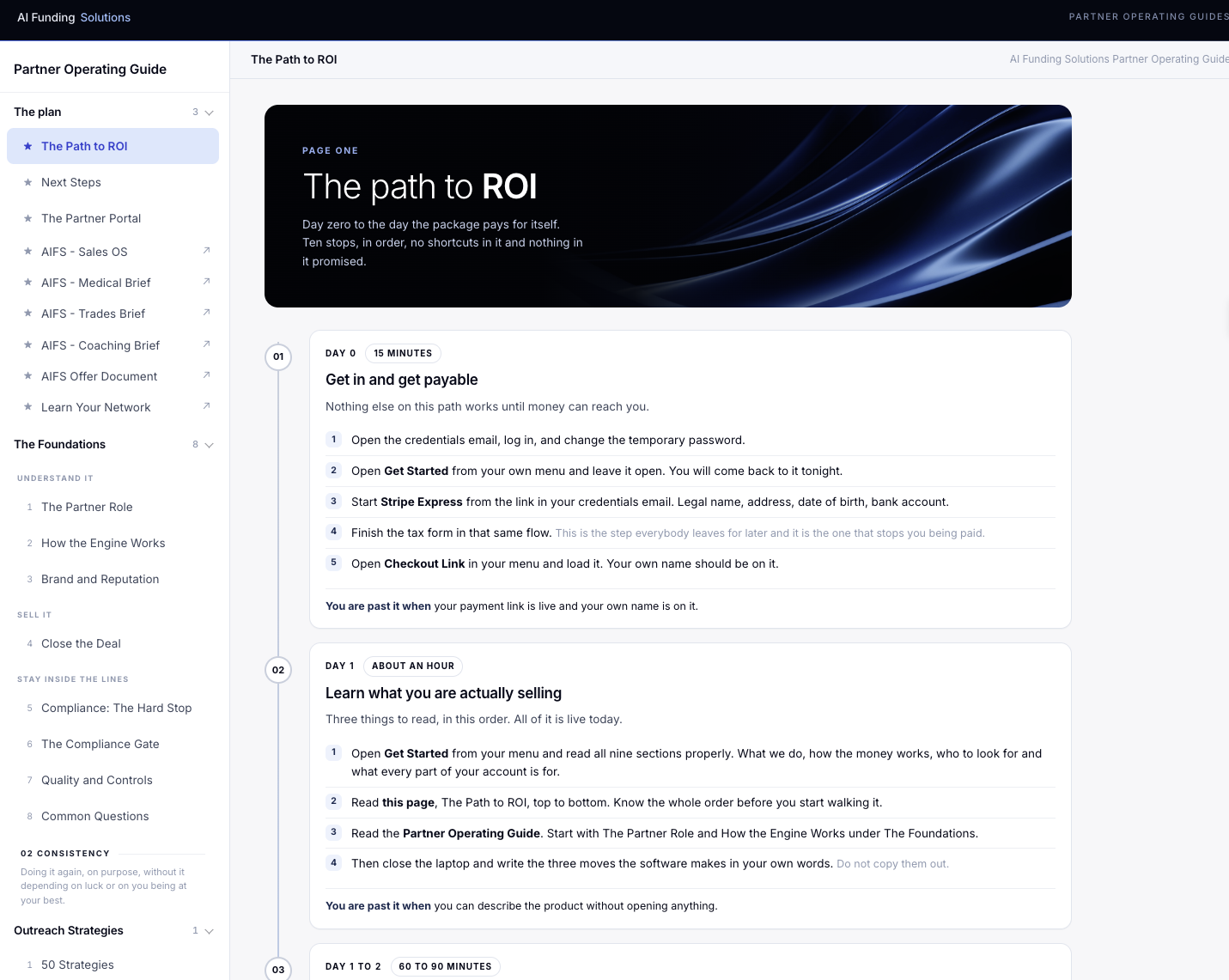
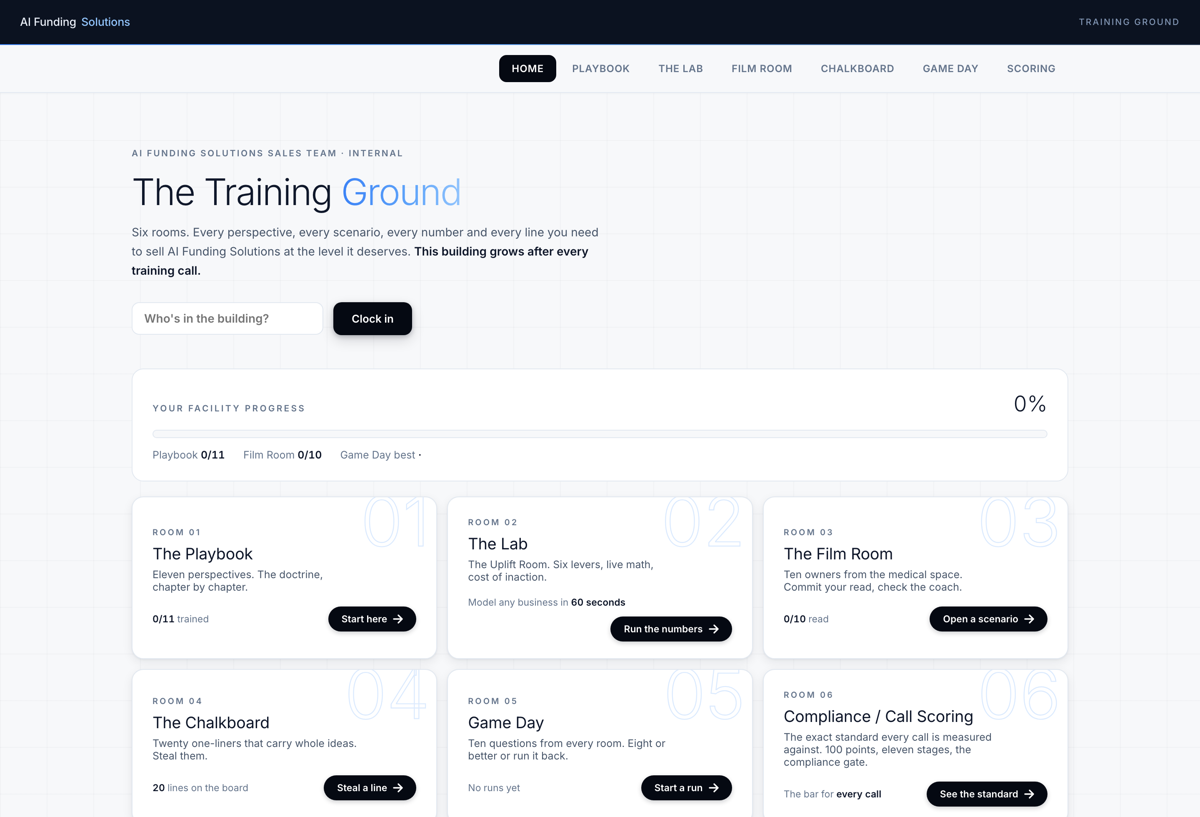
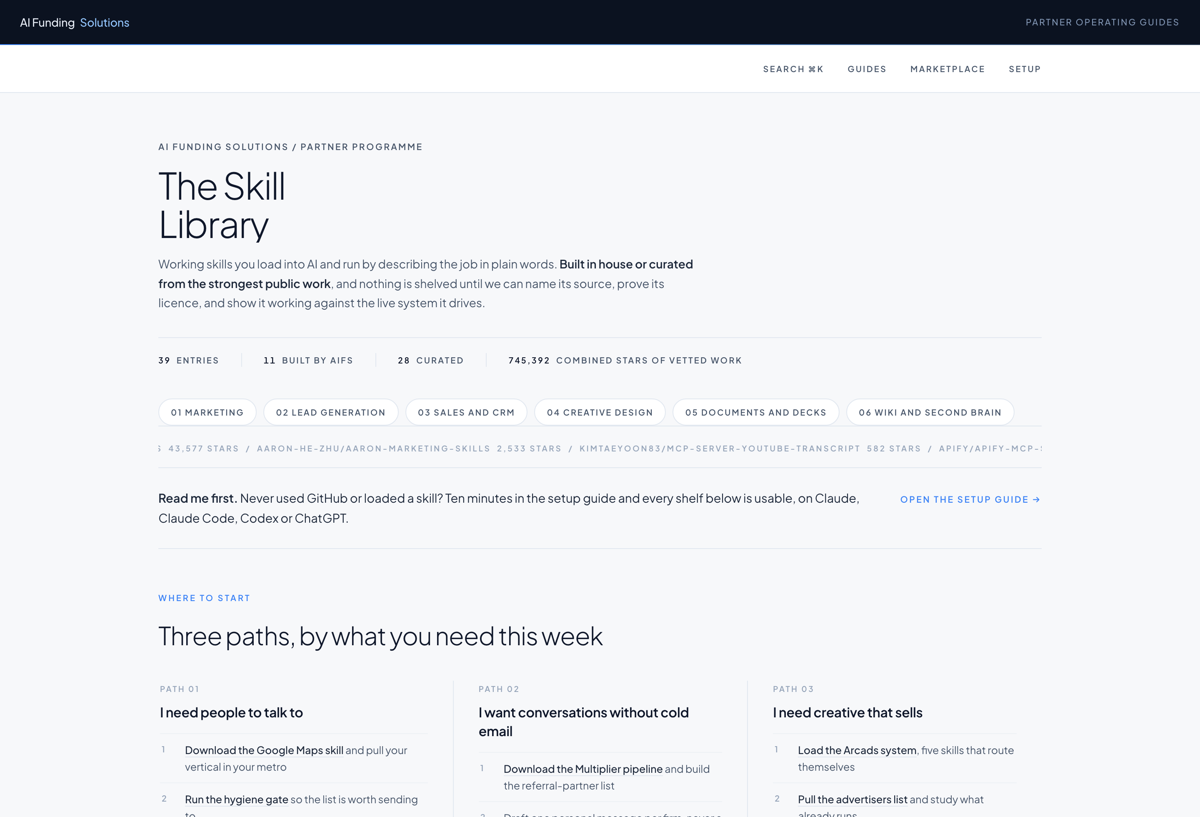
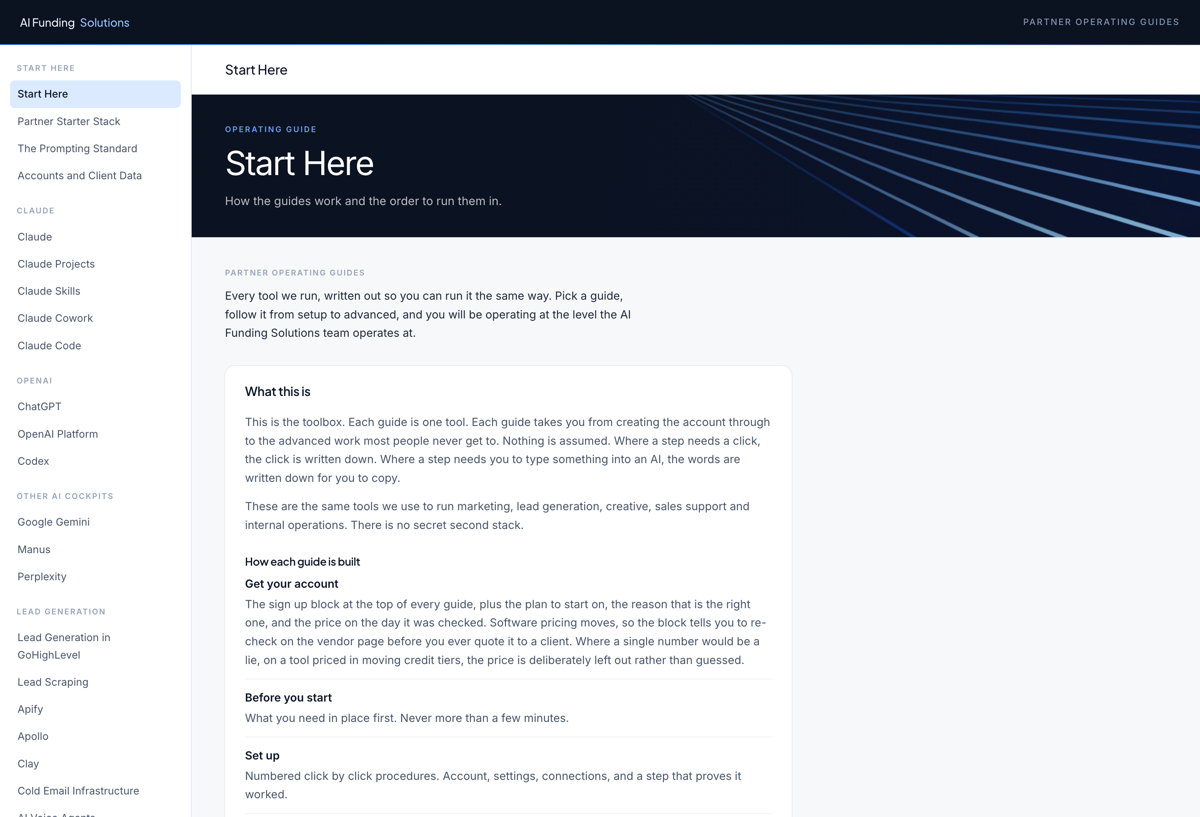
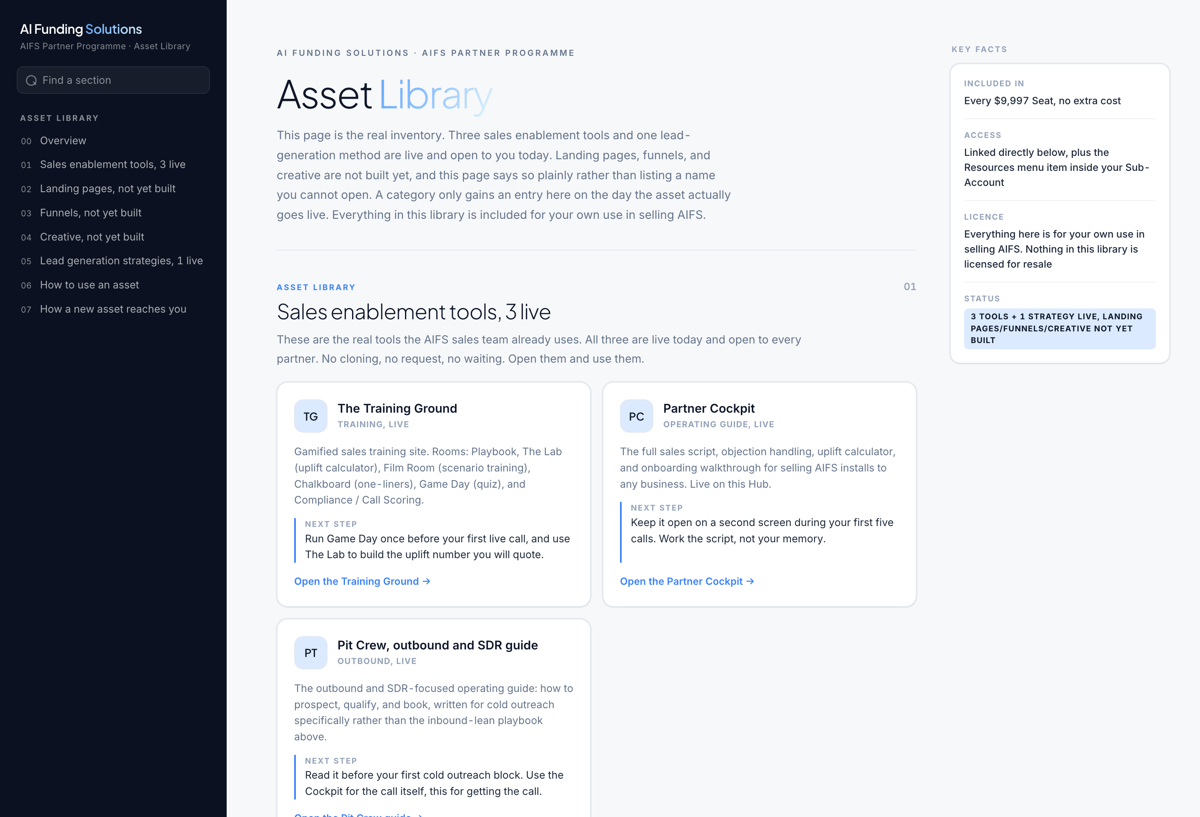

A glimpse rather than the tour. Six of the live surfaces partners work in today, exactly as they look, and there is far more behind them.
And the part that is not on the list
Every business you sell is installed, onboarded and supported by us. You are not learning to deploy software, you are not on the technical calls, and you are not the one a client rings when something breaks. That is ours. You keep the relationship and we run the platform, and those two things are deliberately separate.
How you get paid, in one page.
There is no invoicing, no waiting on a payout run and nothing held back. The split happens inside the transaction itself.
80% to you. 20% to us.
A business pays a fixed install price of $4,997 and Stripe splits it as the payment is made. 80% lands in your own Stripe balance immediately. The other 20% is ours and it covers the install, the onboarding and the delivery work that follows.
Because the price never moves, the only lever you have is how many of the right conversations you have. That is the entire job. Finding the right businesses matters more here than closing technique ever will.
From joining to your first conversation, in about two days.
Most things you could buy take months to become anything. This is worth understanding before anything else, because speed is the whole reason the model is built the way it is.
You join, and that is the last form you fill in
One short form so we can configure your account for you rather than generically. That is the only admin in the entire programme.
Your account is built while you get on with your day
Pipeline, contacts, conversations, calendars, forms, automations and your own payment link. Configured, connected and tested by us before your credentials are sent, with the creative already sitting inside it. You do not set anything up.
We walk it with you and map your first twenty
Screen to screen through your own account, then we take the businesses you already know and put them in order. Which three to speak to first, what to say to each, and why those three rather than the others.
Your first conversations are live
Trained, configured, payable and talking to real businesses inside two days of a standing start. None of it technical, and none of it built by you.
Everything you would normally spend three months building is finished before you log in.
That is what the 20% pays for.And then the work itself, which never changes
| The stage | What it involves | Who does it |
|---|---|---|
| Find them | Work through the businesses you already know and pick the ones that pass the three questions. | You |
| Open it | One question rather than a pitch. Nobody has a reflex against being asked something good about their own business. | You |
| Show them | Send the product brief for their vertical instead of explaining, then get the ones who reply onto a call. | You, with our material |
| Close it | Send your payment link. There is no proposal to build and no price to negotiate, so there is nothing to prepare. | You |
| Install it | Deployment, onboarding, training and support for the business you just sold. | Us |
| Support it | Everything afterwards, for as long as that business runs it. | Us |
Why you, specifically
What you are already holding that makes this work, and what changes once you point it somewhere.
Where your opportunity actually is. You are already holding it.
Most people read something like this and think about whether they could learn to sell it. That is the wrong question. The right one is what you already have that most people do not, because in every case below it is the expensive half and you finished building it years ago.
You can install it in your own business before you ever sell it
What you already have. Live ad accounts, funnels you control, and a book of clients who trust you with their lead generation. That trust is the hardest asset in this entire business to build and you finished building it.
Where the opportunity is. Put it on your own traffic first. Within days you are reading every lead you generate on real financial data instead of guessing. From that point you are never describing this product to anybody, you are reporting on it.
Then it turns outward. For every client you already have, it is an immediate lift in the quality of the leads you are handing them, which is the one thing that decides whether they keep paying you. The qualified data builds positive and negative audiences off real financial signals rather than form fills, so the campaigns you are already running get sharper every cycle. Top of funnel to close, on work you are doing anyway.
You have the problem, and you have a phone full of people who also have it
What you already have. A business that lives the exact problem this solves, and a network of other owners you actually talk to. Not contacts. People who take your call.
Where the opportunity is. Run it in your own business first, so you are never selling from theory. You are telling somebody what happened in yours. Owners believe other owners in a way they will never believe a salesperson, and that gap is worth more than any script.
It is not your reach. It is who your reach is to
What you already have. Years of relationships inside a specific industry, at the level where things get decided. You know which businesses quote in person, which ones run a sales team, and whose name is on the door.
Where the opportunity is. That map is the exact filter this product needs, and almost nobody has one. Most people start this by working out who to approach. You start at the end of that problem, on day one, with names and numbers that already answer.
You have lived the complaint hundreds of times
What you already have. First hand knowledge of the precise pain this removes, and a list of every company you have ever closed for.
Where the opportunity is. You have spent an hour with somebody who was never in a position to buy, over and over, and you know exactly how that feels for the business paying for it. You do not have to learn this pitch. You have been on the receiving end of the problem. And every sales floor you have ever worked on is a business that fits the criteria.
The half you are good at is the half that is left
What you already have. The ability to build a machine, run it, and do it more than once. What has always been in short supply is a finished offer worth putting through it.
Where the opportunity is. The product, the delivery and the material are done. What is left is distribution and systems, which is the part you are actually good at and the part that scales.
Every one of you already owns the expensive half. What has been missing is something to point it at.
That is the only thing this adds.The transformation, stated plainly.
This is the part that actually matters, and it has nothing to do with money. It is a change in what you own, what compounds and what happens when you stop. Read the right hand column as a description of a different job rather than a better version of the one you have.
From “I get paid for what I do” to “I get paid for who I can reach.”
That is the whole shift and everything above is a consequence of it. The first sentence has a ceiling made of hours and it resets every month. The second has a ceiling made of relationships, and relationships are the one thing you can build deliberately, that keep working while you sleep, and that nobody can take off you.
It is also the reason the people who do well here are rarely the best salespeople. They are the ones who already had access and finally had something worth walking in with.
What happens next
The questions everybody asks, and what the session is for.
The questions you are already asking.
The ones that come up every time.
I have never heard of AI Funding Solutions. Why should I believe any of this?
Do I need to understand the technology?
What if I have never sold software before?
How long until my first deal?
Is this an affiliate scheme?
What does it cost to become a partner?
What if another partner approaches the same business I do?
Can I install it in my own business, or in a client's?
What support do I get once I am actually selling?
Do I have to stop what I am doing now?
How much time does this need each week?
What are you not telling me?
You do not have to become a different person. You have to carry a different thing.
None of this asks you to learn a new trade, build a product or get better at selling. It asks you to point what you can already do at something that pays you properly and then leaves you alone.
What happens when we actually speak.
A brief can explain a model. It cannot show you the thing itself, and it cannot tell you whether it works for the people you happen to know. Three things happen live that cannot happen on a page.
We open the account and walk it live
Not a screenshot. The real thing, on screen, with real businesses moving through it. This is the part almost everybody says they wish they had seen first.
We go through the businesses you know
Not a hypothetical market. The ones you can actually reach, checked against the three questions, so you leave knowing where you would start.
You get every number in full
What it costs, exactly what that turns on, and the answer to anything in here you want pushed on. Nothing held back and nothing revealed at the last second.
Have a look at who this actually sells to.
Open the vertical list and read through it properly. Four verticals and seventy five types of business, each one written up with how to spot it, what actually hurts, and what to say first.
It is worth twenty minutes because it makes the size of this obvious in a way no pitch can. For somebody with the ability to introduce a piece of agentic software to a business owner, the list of opportunities is effectively endless. Every town has these businesses and almost none of them know this exists yet.
Open the vertical list ↗Two ways to take it further
A one to one call with our team
Forty five minutes, screen to screen. We walk the live account, go through the businesses you can reach, and answer everything in this brief properly rather than in headlines. If the fit is wrong we will tell you on the call.
A live workshop with the team behind it
Meet the people who built the software and who install it. See it run, hear how partners are actually selling it right now, and ask anything in the room. If you would rather look before you speak to anybody one to one, start here.
Go back to the person who sent you this brief.
Tell them which of the two you want and they will get it booked. That is the entire next step.
AI Funding Solutions LLC provides software and facilitates introductions to third party providers. We are not a lender. Nothing here is a promise, projection or guarantee of any income, result or outcome, and no figure should be read as one. Pre qualification is a soft check with no impact to a consumer's credit score. Partner earnings depend entirely on the partner's own activity and results. Prices are set by AI Funding Solutions and are current at the time of writing. Terms and Conditions and Privacy Policy available on request.